
Surviving Singapore
How one soldier’s choice changed the course of my family’s history
On the 15th of February 1942, the British army surrendered Singapore to the Japanese after just seven days of fighting.
After the surrender, the Japanese began rounding up Chinese locals (or anyone they thought might oppose them) for "processing”.
But what really happened was that many were taken down to the beach and shot, in what would later be remembered as the Sook Ching Massacre.
Up to 70,000 civilians were killed.
Among those at risk was a Peranakan family (Chinese Singaporeans who’d migrated through Malaysia), the Tans, who lived near the beach.
They had eight children, the youngest a girl named Chwee Heng, and were doing their best to avoid the soldiers.
But one day, a Japanese officer came to their house.
He was half Japanese, half Taiwanese. And because of his Taiwanese heritage, he felt empathy for the Peranakan people, reportedly saying "This is not my war" and spared the Tans.
He even placed a sign on their door instructing that they were not to be harmed.
And because of that, the Tans survived.
Years later, Chwee Heng married a British soldier who’d served as a medic in the Vietnam War (their first date was at the famous Raffles Hotel).
They moved to Australia, had three kids and seven grandkids. One of whom is my wife Jen!
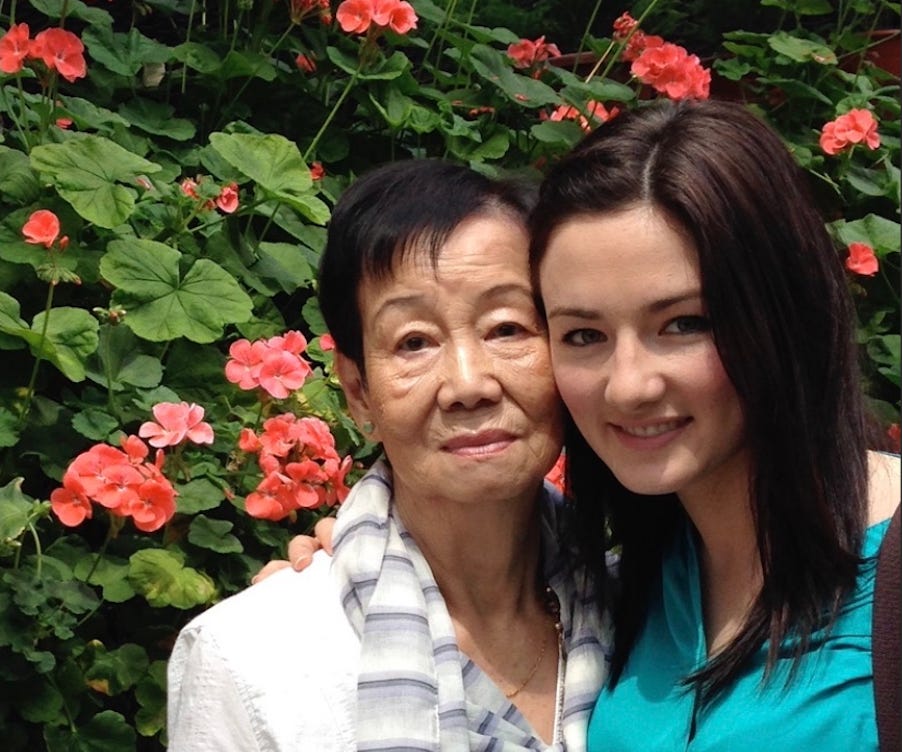
And I’m sharing all this because last year, Chwee Heng (Nan) passed away aged 91.
Now I’m in Singapore with Jen and our girls walking the same streets Nan once did, introducing them to their Peranakan family and heritage.
And after hearing this story at her memorial yesterday, all I can think is what if that soldier hadn’t shown mercy? Would my wife or kids be here?
Maybe they would. But it’s still an incredible moment in my wife and daughter’s family history, and think their very existence possibly traces back to a single act of empathy.
Empathy shown in a time of war.
I also learned that Nan passed just two days before the 50th anniversary of her husband's death.
He died by suicide three months after retiring from the Army, having struggled with PTSD, leaving Nan to raise three young children on her own. And with limited English.
But Nan was always a glass-half-full type of person.
Despite everything she went through, she was a great example of the saying, "You aren’t what happens to you, you are how you respond."
She was always so warm and welcoming to me when I first started dating Jen, offering to teach my mahjong.
She’d even call me "stranger" if I'd been away on footy tour too long and hadn’t visited.
But sadly, her time on this earth has come to an end, and I’ve written this to help capture her story so my girls, and their kids, will never forget the events that shaped their origins.
RIP Nan. Thank you for being so welcoming.
Note: The British tried to blame Australia (and India) for the fall of Singapore, since Aussie troops were defending the section of coastline where the Japanese first invaded.
Instead of owning their failure of leadership and preparation (like the lack of building proper defence infrastructure on the northern side of the island) the Brits scapegoated the front-line troops.
This lead to former PM Paul Keating later calling it a “betrayal” and said Australia must never again rely on Britain. Which trigged a shift to an independent defence policy, closer aligned to Asia and the US.
One of your best, Ben. Great stuff. What a yarn. What a Nan!
What a beautiful story Ben. Thank goodness for the actions of the Japanese Soldier. You guys were meant to be & it all goes back to his actions.